
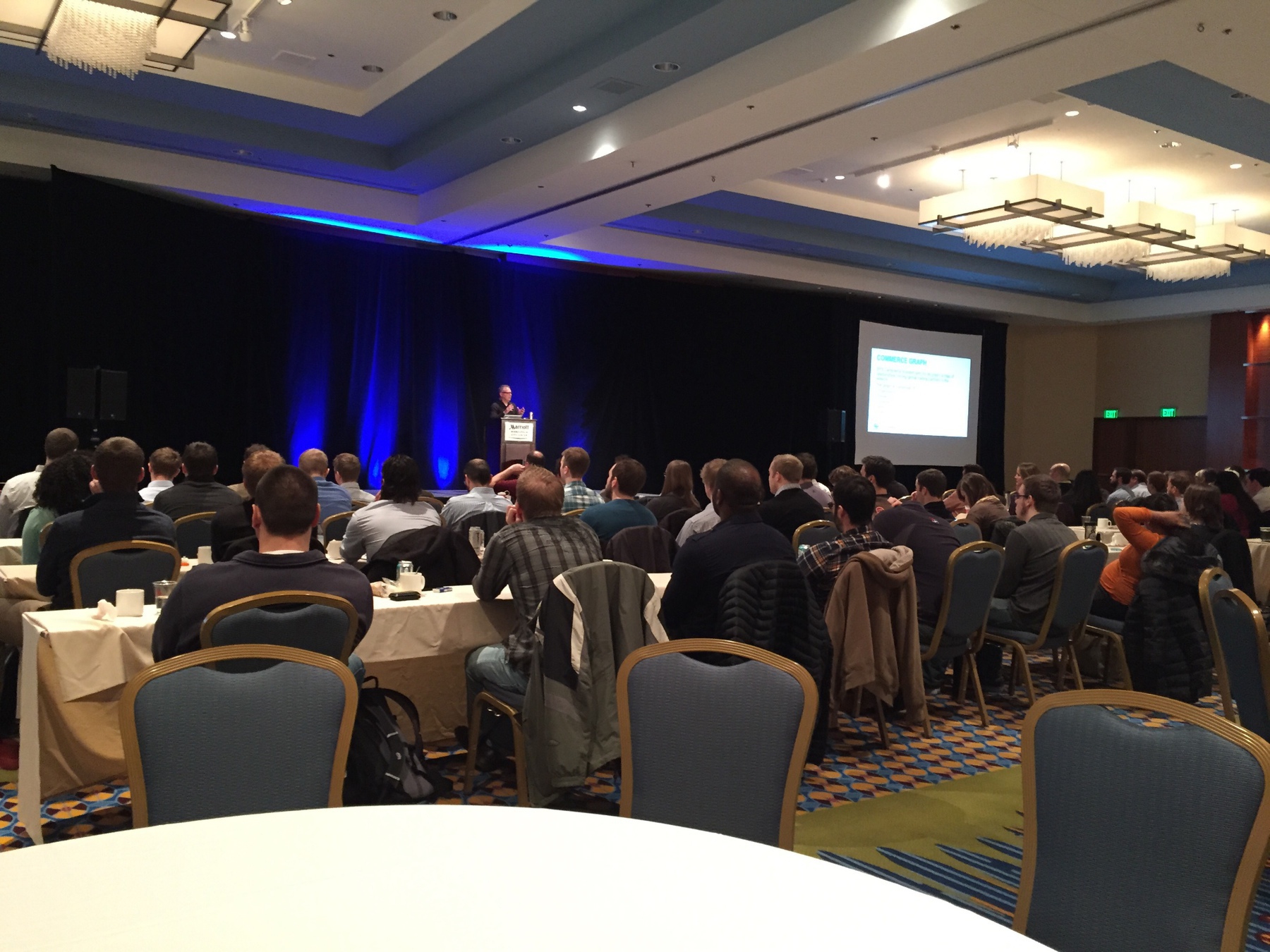
Peter Zaballos addressing #TeamSPS today.
First time at Red Wagon Pizza! Like that this and only 2 blocks from home. Great beer list to boot.

Software for Good as B Corporation
I’m really enjoying watching Casey Helbling and the team at Software for Good evolve their mission and business. They just transitioned to a B Corp structure.
We’re celebrating the new year in a big way: Today, the much-anticipated Minnesota Public Benefit Corporation Act went into effect, and Software for Good was one of the first to file as a benefit corporation in the state of Minnesota.
If you are not familiar with a Benefit corporation, Wikipedia of course has a great overview.
The purpose of a benefit corporation includes creating general public benefit, which is defined as a material positive impact on society and the environment. A benefit corporation’s directors and officers operate the business with the same authority as in a traditional corporation but are required to consider the impact of their decisions not only on shareholders but also on society and the environment. In a traditional corporation shareholders judge the company’s financial performance; with a B-corporation shareholders judge performance based on how a corporation’s goals benefit society and the environment. Shareholders determine whether the corporation has made a material positive impact. Transparency provisions require benefit corporations to publish annual benefit reports of their social and environmental performance using a comprehensive, credible, independent, and transparent third-party standard. In some states the corporation must also submit the reports to the Secretary of State, although the Secretary of State has no governance over the report’s content. Shareholders have a private right of action, called a benefit enforcement proceeding, to enforce the company’s mission when the business has failed to pursue or create general public benefit. Disputes about the material positive impact are decided by the courts.
Allowing a company to pursue things beyond pure profit and shareholder return, without having to be a non-profit, makes a lot of sense. It provides an opportunity for companies to be better citizens.
Snowy Minnehaha Creek.

Christmas Eve steaks on the Big Green Egg. Nice grilling weather!

Lego Firetruck

Modern Legos seem so very different than the generic shapes I remember when I was a kid. Did Legos take over the plastic model scene from my childhood? These pieces are so specific to each solution. Very proprietary, in software terms. 😀
Blokus

I got Blokus for Christmas in the brother-in-law swap on the Olson side (thanks Max!). It’s a really fun game. Ultimately best suited for 4 players with a graceful way to play with 2 players. 3 players works but its not a great fit. The strategy of the game is to block other opponents off as they try to lay tiles down on the board. While Go players would probably cringe at the comparison it seems loosely related.
Happy to see Dollar a Day pick EFF today! Have been an EFF member for many years.
The Chess Master and the Computer by Garry Kasparov
A compelling read on how an objective was achieved, but not really. This part from the end of the article really struck me:
This is our last chess metaphor, then — a metaphor for how we have discarded innovation and creativity in exchange for a steady supply of marketable products. The dreams of creating an artificial intelligence that would engage in an ancient game symbolic of human thought have been abandoned. Instead, every year we have new chess programs, and new versions of old ones, that are all based on the same basic programming concepts for picking a move by searching through millions of possibilities that were developed in the 1960s and 1970s. Like so much else in our technology-rich and innovation-poor modern world, chess computing has fallen prey to incrementalism and the demands of the market. Brute-force programs play the best chess, so why bother with anything else? Why waste time and money experimenting with new and innovative ideas when we already know what works? Such thinking should horrify anyone worthy of the name of scientist, but it seems, tragically, to be the norm. Our best minds have gone into financial engineering instead of real engineering, with catastrophic results for both sectors. via The Chess Master and the Computer by Garry Kasparov at The New York Review of Books.
I’d add advertising optimization to the other items our best minds have gone into.