
Canadian Fishing Trip Intro
I will soon be departing on a Canadian Fishing Adventure. T-minus nine days before I head out with my father-in-law and all my brother-in-laws to Canada for a week of fishing giant fish. Really giant fish. Fish that, if you are not careful, can severely injure you. I’m not an expert fisherman. I’m not even a basic fisherman. I haven’t fished for a decade, and this trip will double the amount of time I’ve fished in probably my entire life. This fills me with some trepidation.
However, I’m also really excited. This isn’t the type of trip I would typically go on so it’s fun to try something completely outside of your typical zone. Plus, fishing is loaded with gear and I’m a gear addict so that is fun. We’ll be departing for our trip and heading into the great unknown with a sun that never sets and more water than land, GPS in hand of course.

We’ll be eating a lot of fish. I’m going to pack some extra stuff just in case. I’ve ordered some wacky natural bars to take along called Figamajigs. They are supposedly pretty good, and should be a nice break if desired.
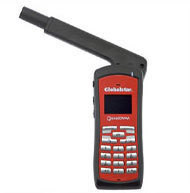
We are going to be totally off the grid. Forget the Internet. Forget phone lines. Forget cellular. There is a little bit of power via a solar panel and a generator that can be started from time to time. Digital cameras and such can be charged, but that’s about it. This will be the longest that I’ll have gone offline for quiet some time. The urge to pick up a satellite phone is strong, but the price point is enough to push that urge aside. Plus I’d probably be stoned if I showed up with some crazy phone.
I’ve got a little bit of additional gear to get or arrive via UPS. We are limited to 80 pounds of gear and I’m probably going to be right up against that with fishing stuff, photography stuff and clothes. I’m going to journal while I’m there and post when I return. I’m looking forward to the northern waters, really huge fish, time with the guys and giant fish stories to lie about when I return.
2007 Olson Family Weekend
This year was the 4th annual Olson Family Weekend! This year was Angie’s turn to plan and there is only one more year before we loop back around for the next round of trips. It was a great weekend and Angie did a great job putting it all together.
We had a great weekend up at the Lundeen’s cabin (huge thanks to Lundeen Sr. for allowing us to overtake their cabin!). The cabin was cramped with 11 people and 3 dogs, but it added to the fun actually. The weather was sketchy but that didn’t slow anyone down either.
Rather than reading, go take a look at the pictures from the
weekend, or
watch a couple of videos of Mazie from the weekend (thanks for the
videos Angie!) [I removed the videos from YouTube].
Serious Development in JavaScript

JavaScript is a really powerful development environment. Really.
Many developers don’t agree with that statement. I think there are a couple of reasons for that. First, the word “script” appears in the name of the language and developers are often pejorative of anything with the script word in it. The logic goes something like scripting may be fine for hacking out little things, but cannot be used to build real applications.
I think the other black eye for JavaScript was that the first uses of the language were purely trivial. Remember the first time you had snowflakes falling on a web page? Or how about going beyond blinking text to text just jumping all over the place. True, the first implementations using the language were primitive.
There are other issues that you could highlight. There are no threads. It’s not compiled. Namespace is very loose. But this all misses the point that some of the most sophisticated and sexiest web applications out there are largely built in JavaScript. I personally spend a lot of time everyday now in JavaScript applications thanks to Google. Developers need to focus more on this language as a serious development environment, and the tools for it need to catch up. Venkman is nice for debugging, but more is needed. Further tools like Google Gears will extend JavaScript even further including off-line.
The May 2007 issue of MSDN Magazine featured a cover article called Create Advanced Web Applications With Object-Oriented Techniques (whew, mouthful) that touched on building JavaScript in a more sophisticated way. It’s a good read, and will start your thinking down the path of using JavaScript for more than snowflakes falling off your mouse pointer.
Congrats to my sister Alona for passing her social work exam!
Going Offline with Google Gears
I just spent a little while getting caught up on a variety of sites with Google Reader. Reader is my RSS tool of choice. This isn’t all that special, except that I did it while sitting on an airplane.
Last night Google released the first “developer release” (alpha?) of Google Gears, and along with it Google Reader got a revision to allow you to go offline using Gears. The experience was pretty amazing. Reader works just as you would expect it to. You launch your web browser, go to the Reader URL and instead of the expected error since your not online, you actually get the site but in offline mode.
This is a first release for Reader using the offline capability so it’s a little overly modal (either offline or not) and some features are frustratingly unavailable, particularly marking all items read. To my surprise sharing items is available.
Google Gears, the technology that makes this all possible, provides a nice suite of features to make this all work. I’m assuming that the Googleplex is hard at work on making an offline version of GMail, it’s the most obvious next candidate. I did a little poking around the developer documentation for Gears and I was really excited to see that all the hooks are there for ‘sometimes offline’ applications. With a little bit of ingenuity we should see web applications that seamlessly go online and offline as needed. I’d love to see this in a number of tools – all the 37 Signals applications, Wordpress, Google Calendar.
I think this is a big moment. The Internet is nearly pervasive, but there are times when it may be unavailable. The biggest net benefit of technology like Gears may be in making applications much more resilient to transient network failures – in addition to the offline experience.
It will be worthwhile to keep a close eye on this space.
Update
I used this on the flight back with a lot more unread items and it again worked great. Going offline took more time since there was more data. The lack of a mark all as read feature in offline Reader is a real pain though.
Update 2
I tried getting this going in Firefox on Vista and the installer fails. The Mac OS X Firefox install is a breeze and is just a browser plugin. The Windows install is a separate installer. YMMV.
Used the BlackBerry 8800 + GPS + Google Local to get coffee in completely random locale. Now watching myself walk on the map on the BlackBerry. Geek++
Car service is a fully decked black suburban! I feel like I’m in the secret service. Where is POTUS?
iTunes 7.2 just showed up in Soaftware Update with DRM-free downloads. Guessing I know what Jobs said at AllThingsD.
Dissapointed that it seems very hard, to impossible, to get a plug-in converted Toyota Prius.
My Robot and Steven Wright
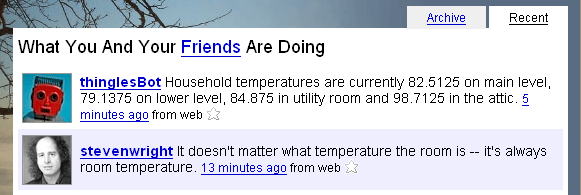
A friend of mine forwarded this screen capture from a friend of his who grabbed this great Twitter moment. It seems my robot and Steven Wright (also on Twitter) are on similar wavelengths.
Drive to Work Take 2

Time for “Take 2” of my drive to work time elapased video!
I really liked the first take at this, but the camera was mounted very poorly. Think tape combined with a rear-view mirror and you get the idea. It was swinging around and shaking with abandon, which caused a ridiculous video. I was looking at getting a Gorillapod for my trip to Canada in a couple of weeks and it was also the perfect tripod to mount a camera on my dash. This, combined with an overcast day that gave more even light and a closer position to the windshield to eliminate a lot of the grime on the glass made for a significantly better video.
For comparison, here is the first one as well. Try hitting play on both of these at the same time to see the differences.
Directory Structure for Digital Photos
It seems that a lot of people have a hard time settling on a file structure to use for their digital photos. There are a number of different approaches, and the tools that you use will heavily influence this but I think it’s important to settle on something independent of your tools since those will change over time.
There are a couple of things you want to make sure to accomplish with the directory structure that you use for your photos.
-
Consistency is important. You want to make sure that regardless of camera, subject or any other variable there is a consistent way to find a photo.
-
Uniqueness of photo name is important. Even though the directory structure would allow for multiple files with the same name, you should guarantee that every file is unique and “fully qualified” for each individual photo.
-
Backup management is handled most simply through your file structure. I don’t like to rely on fancy backup programs to know what has been backed up or not, I like to be able to achieve this through chronology.
I’ve been using the following structure for over 5 years and I’ve found it to work very well. I’ve used it with a number of different photo management programs, including my current favorite, Adobe Lightroom. It is inherently driven off of the timestamp of the photos.
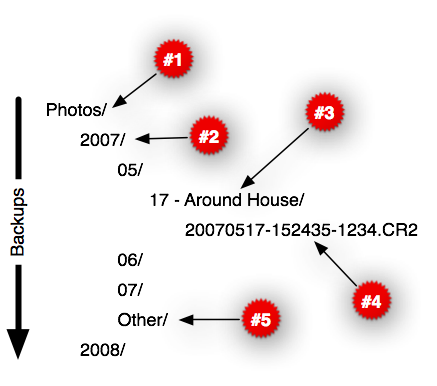
Let me highlight the five critical sections of this (cross-reference to numbers above, sorry Tufte).
-
Your photos live in a root directory. This could be anywhere and just identifies the home of all photos.
-
Start your directory structure with the year. There should be a year for every year you have photos. This cascades into months and finally days.
-
The “day directory” itself is typically auto-created by your importing software but it likely won’t have the a title for it (e.g. “Around House”). I add this myself, and I have an additional trick in that I don’t add that text until I’m done doing post-processing on those photos (purging, keywords, metadata, etc). The other reason to add a title is to give you some visibility on what you are looking at when you are just looking at your directory structure.
-
The filename itself is really simple. I always use YYYYMMDD (year, month, day), dash, HHMMSS (hour, minute, second), dash, and lastly the serial number of the photo from the camera. The serial number is important since you may take photos in burst mode and have more than one in a second. Or, if you are shooting with multiple people and multiple cameras, and happen to take a photo in the same second, you are still unique. I could put more here (camera serial number, ISO, etc. but I’ve never found it necessary). The completeness of the timestamp inside the filename is great. I can always figure out the full path to any file just using it’s filename.
-
The last “Other” is a catch all. Sometimes I get copies of photos that other people take. I don’t typically interleave these with my photos, and instead just drop them in the Other directory. This is a catch-all for such photos, sometimes even having directories inside other like “Bob’s Trip to Alaska”, that is all grouped together. The other directory is last which is helpful for backup.
The backup strategy for this structure is a simple top-down flow. I never backup a month until it’s completed. The great thing here is that once the time has passed, the directory and files in those directories are not changed so you don’t have to worry about going backwards in time. (Note, I also mirror files every night, and this is automated to other discs.)
Just bought greenrequest.com.
Got home after running (and walking) my first 5k in forever.
Wondering if anyone I know uses StumbleUpon? If you do, ping me.
Sitting down to watch “An Inconvenient Truth” again. First time.
What food would you give up the Internet for?
Tammy and I had a really funny conversation today on the way home from the grocery store. I prompted the question of giving up the Internet for something. For example, if you were forced, would you give up chocolate, or the Internet. Forever. Not a month, but permanently. Would you never have another bite of chocolate so you could continue to bathe in the wonders of the Internet.
To me this question was simple – I’d be passing on the chocolate. I love chocolate. Don’t get me wrong. Lindt and Vosges are very special brands in my book. But compared to the Internet, it’s no question.
I theorized that if given the choice of continuing to use the Internet or drinking nutrient complete meal replacement shakes that I would have to think for a long time. What flavors exactly? Tammy laughed at me, citing that I wouldn’t make it through a single Thanksgiving.
So, that made me wonder, what would your breaking point be? What food do you care so much about that you would abandon the Internet forever for it?
Solatube Installed
A few weeks ago I was flipping through a recent issue of Home Power magazine and I stumbled upon an article abut solar tubes. (Sorry, I would provide a link to the article but they don’t make it available online.) Solar tubes are not new technology, but there has been some pretty amazing improvements in recent years. The author of the article had installed a Solatube in his office and was very pleased with it.

Shortly after this we ran into Solar Midwest while we were at the Living Green Expo. They had the Solatube units on display and I got to ask a ton of questions. Shortly after that I got a quote and decided to get one installed.
The basic principle of the Solatube is exremely simple. You mount a light collector on your roof. You then run a 10" or 14" tube that is exceptionally reflective to a room in your house. There are three main areas of technical focus. Making the collector dome as efficient as possible, losing as little light as possible in the tube, and distributing in the room in an even way. This diagram from Solatube’s website sums it up well.
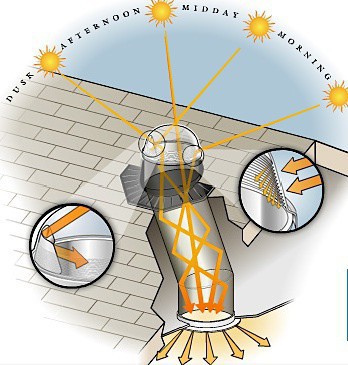
The advancements in the collector dome and the efficiency of the pipe are incredible. It can collect light all day, picking up even dull light on a cloudy day. There is no need for direct sunlight. The tube itself is extremely efficient and loses very little light.
Let me skip to the after shot. Here is the room with the Solatube.
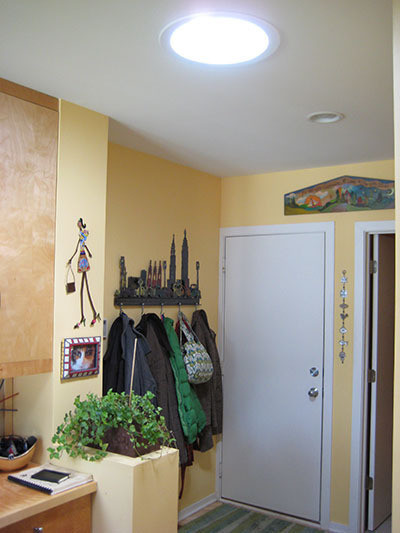
The effect is shocking. This room was one of the more poorly lit areas in our upstairs, and now it is as bright and enjoyable as the most windowed areas in the house. Note the relative sizing of the Solatube versus the cans next to it. This is the 14" unit and it delivers a whopping amount of light. Tammy and I are both very pleased with it and are thinking we will likely have two more installed at some point in the future.
Some FAQ items to share with everyone, in no particular order:
Does heat transfer through it?
Surprisingly no. The Solatube itself is just sending the light. The heat part doesn’t make it down.
What about storms?
I felt the dome, and it’s impressively thick. I’m not sure exactly what would take it out, but I’m very confident the roof around it would have issues before the dome itself cracked.
Is it ugly?
It’s another thing on your roof, so you may not like that. We were able to install it in a location that is completely invisible.
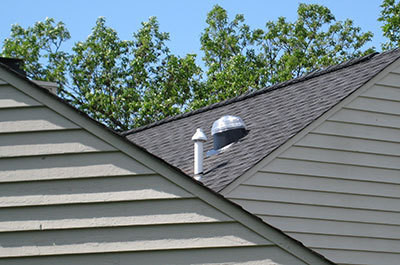
Due to this great placement you cannot even see the dome from the street. I don’t think it would be an issue even if you could see it.
Does it save energy?
Well, it depends. If you have rooms that you use lights during the day it definitely would. Our situation was more of a luxury since we like a lot of light and this room was just dimly lit. We didn’t use lights there that much during the day, but it was drab. Now it’s bright and full of light.
Great locations for this technology would be a windowless bathroom, or a closet. Those are the locations we are considering for a future use. Or frankly anywhere you want nice, full-spectrum sunlight.
Would you recomment Solar Midwest?
Yes, they did a great job through the whole project. As a bonus, all the pre-sales activity was via email which I appreciated.
What about basements?
To me the killer utility of solar tubes is in the basement of a house. This is easily done in a new build, but nearly impossible in an existing house due to the tubing required. I can only dream of the day when I pipe a bunch of natural light into the lower level of a new house.
Can you see moonlight?
Yes. There is a cool bluish glow on a full moon.
Finished watching Children of Men. Hmmm…

Drive to Work
I’m having some more fun with the time-elapsed feature of my new camera. It has an ability to take the most trivial things and make them at least a little interesting. Check out this video of my morning drive. There is a decent amount of sun glare, and the “mount” wasn’t all that great, but it’s still fun. I think I’ll do it again after I get a Gorillapod that will give me a better mount. Until then…
Also check out the short time-elapsed video of my flight take-off.