
Living in Minnesota it gets cold. Really cold. But this is a bit over the top.

Yeah, like I said. Cold! We were going along just fine and then boom, this cold front came in.
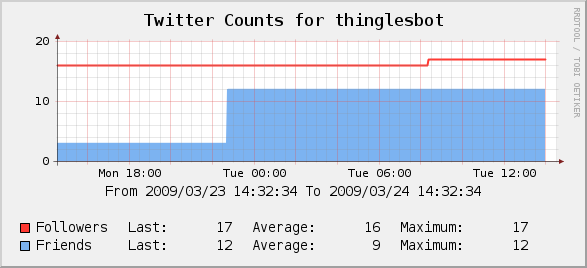
Saturday is letting itself be known. Oh, and all this is without the wind chill. And it is windy!
In Defense of Food - An Eater's Manifesto
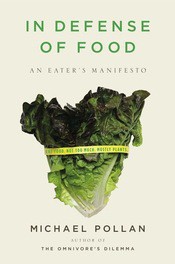
I just finished reading Michael Pollan’s newest book, In Defense of Food: An Eater’s Manifesto. It is a well-written and well-researched book that dives into the Western diet and deconstructs it in three parts: The Age of Nutrionism, The Western Diet and the Diseases of Civilization, and Getting Over Nutritionism. I’ve heard this book referred to as the follow-on to his wildly popular The Omnivores Dilemma (which, in full disclosure I have not read, yet).
I found In Defense of Food particularly interesting in part because of my own view of food and how it has evolved. A decade ago I was completely clueless about food. If I was asked how many calories were in a cheeseburger I could have easily agreed with 100 or 4,000. I really had no idea. Then while focusing extensively on fitness and diet I started logging every bit of food that passed my lips. I was focused in a nearly obsessive manner (nearly? who am I kidding) on how many grams of various macronutrients I got and precisely how many calories I consumed. To put a point on it, I weighed my fruit on a gram scale before and after eating it to determine the precise intake. Yeah, that is obsessive.
This is not behavior that you can model forever and when I stopped doing it I learned that I hadn’t really learned how to eat, but instead had become a discipline of nutritionism. Nutritionism is not Pollan’s term, it was coined by Gyorgy Scrinis. The behavior and mindset that it describes though is the antithesis of the most basic suggestion on how to eat.
Eat food. Not too much. Mostly plants.
Those are the first seven words in Pollan’s book and admittedly you could stop reading there. The remaining 200 pages dive into the details of the Western diet and the issues with it. Pollan’s writing is interesting throughout and even the deeper dives into the roots of nutritionism are immensely interesting. He does a great job of highlighting for the reader just how much our food system has changed, and in most ways for the worse, in the last 70 years. This paragraph really hit me hard. I expected corn and high-fructose corn syrup to be the evil doer in this book, but the bases of nutritionism predates that trend.
Of all the changes to our food system that go under the heading “The Western Diet,” the shift from a food chain with green plants at it’s base to one based on seeds may be the most far reaching of all. Nutritional scientists focus on different nutrients – whether the problem with modern diets is too many refined carbohydrates, not enough good fats, too many bad fats, or a deficiency of any number of micronutrients or too many total calories. But at the root of all these biochemical changes is a single ecological change. For the shift from leaves to seeds affects much more than the levels of omega-3 and omega-6 in the body. It also helps account for the flood of refined carbohydrates in the modern diet and the drought of so many micronutrients and the surfeit of total calories. From leaves to seeds: It’s almost, if not quite, a Theory of Everything.
Throughout the book Pollan deals with the challenge of arguing nutritionism while not falling into the logic arguments it naturally suggests. I was happy to see him recognize this later in the book, and I thought it appropriate. After all, to have a book that suggests that you have to stop looking at food as grams of chemicals, and then just suggests that you start gardening would be incomplete and unhelpful.
The undertow of nutritionism is powerful, and more than once over the past few pages I’ve felt myself being dragged back under. You’ve no doubt noticed that much of the nutrition science I’ve presented here qualifies as reductionist science, focusing as it does on individual nutrients (such as certain fats or carbohydrates or antioxidants) rather than on whole foods or dietary patterns. Guilty. But using this sort of science to try to figure out what’s wrong with the Western diet is probably unavoidable. However imperfect, it’s the sharpest experiemental and explanatory tool we have. It also satisfies our hunger for a simple, one-nutrient explanation. Yet it’s one thing to entertain such explanations and quite another to mistake them for the whole truth or to let any one of them dictate the way you eat.
This is the heart of Pollan’s message. Stop thinking of food as a collection of micro- and macro-nutrients and instead think of it in the whole. This obsessive push to the one thing that will save us is destroying us.
Pollan doesn’t spare the establishment in his analysis. Early in the book he outlines legislation passed in 1938 under the Food, Drug and Cosmetic Act that required the word “immitation” appear on any food that was fake. I love the definition of this “…there are certain traditional foods that everyone knows, such as bread, milk and cheese, and that when consumers buy these foods, they shoudl get the foods they are expecting…” The sad thing is that nearly everything in the modern grocery store would have to be labeled immitation. The requirement was repealed shortly after enacted after protests from the food industry. Nobody apparently wanted to buy immitation spaghetti.
When corn oil and chips and sugary breakfast cereals can all boast being good for your heart, health claims have become hopelessly corrupt. The American Heart Association currently bestows (for a fee) its heart-healthy seal of approval on Lucky Charms, Cocoa Puffs, and Trix cereals, Yoo-hoo lite chocolate drink, and Healthy Choice’s Premium Caramel Swirl Ice Cream Sandwich – this at a time when scientists are coming to recognize that dietary sugar probably plays a more important role in heart disease than dietary fat. Meanwhile, the genuinely heart-healthy whole foods in the produce section, lacking financial and political clout of the packaged goods a few aisles over, are mute. But don’t take the silence of the yams as a sign that they have nothing valuable to say about health.
Pollan doesn’t leave it at just the food either, but the way in which we consume it. I was surprised by one of the statistics cited in the book, that 60% of McDonald’s revenue is made at the drive-through. A healthy meal is not consumed in your car. It may seem unachievable, but having a real family meal is a critical part of a healthy diet.
That one should feel the need to mount a defense of “the meal” is sad, but then I never would have thought “food” needed defending, either. Most readers will recall the benefits of eating meals without much prompting from me. It is at the dinner table that we socialize and civilize our children, teaching them manners and the art of conversation. At the dinner table parents can determine portion sizes, model eating and drinking behavior, and enforce social norms about greed and gluttony and waste. Shared meals are about much more than fueling bodies; they are uniquely human institutions where our species developed language and this thing we call culture. Do I need to go on?
Indeed he does not. In Defense of Food is a great read. If you question your approach to what you put on the table (or don’t put on the table), this is a good perspective on that challenge.
Confluence Case Study

A case study was just posted at the Atlassian website on the use of the Confluence wiki solution at work. Some nice quotes from me in it, and the story on how we’ve been using Wiki’s. It leaves out some of the longer history though. The Wiki use really started in MarketWatch long before Dow Jones bought us, and then spread when people saw how effective the technology was.
Nice writeup though. No big errors in it like these things can have so often.
Happy to be using my MacBook Pro again.
Missed it after a week on that horrible Dell Latitude.
Watching Walt Mossberg talk about the iPhone and technology trends. Cool!
Ann Coulter being interviewed on the TV. The evil is warping the image and starting to melt the plastic.
I can’t have jam.ie, too bad. I could have thingl.es.
The domain maz.ie is actually available. That would be a nice reservation for my daughter. But €75 a year? Ouch!
Debating the merits of a domain that ends in .ly — Libya? Hmmm…
Checked into Holiday Inn in New Jersey. This hotel may redefine the meaning of cheap. So tired!
Just finished great dinner at Los Dos.
Threat level ORANGE! Stay terrified.
Just loaded summer travel plans into Dopplr. Phew!
This weekend we were in a store and I saw this t-shirt. It was a must have for Maze!

If you have trouble reading that, it’s:
AB/CD
FOR THOSE ABOUT TO WALK
WE SALUTE YOU
Awesome!
Impressed by an actually interesting Super Bowl! Congrats to the Giants!
Mazie's First Voicemail
Another “Proud Papa” post. This landed in my voicemail a day ago. Made me melt.
Oh boy…
Mazie and the Mirrors
After swim class today Mazie and I had our usual bagel routine and afterwards we walked down the mall. Along our walk she found these mirrored columns and had a great time.
Delicious Library 2 Interview
I love Delicious Library. Why? Delicious Library to me epitomizes the belief that software can always be better. Fundamentally what Delicious Library does could be easily done in a basic spreadsheet, but that would be incredibly boring. Delicious Library 2 is the long anticipated Leopard-only upgrade to this great program.
Just won the Change Game on $5.67!
Tufte Returning to Minneapolis June 23 & 24

I was checking out Edward Tufte’s site the other day and I noted that he is going to be returning to Minneapolis again for his seminar. I’ve been to his seminar twice and would consider going a third time but I’ll be out of town.
If you haven’t been to his seminar before I really recommend it. It’s like taking a bath in high quality analysis of visual displays. Even if your day job doesn’t directly involve designing it is still a very worthwhile and educational way to spend a day. Plus you get copies of all four of his books.
Jumpnode Network Appliance

For the last few months I’ve had a Jumpnode appliance in my house keeping a tab on all of my computers, the network and other infrastructure. The Jumpnode is an appliance created by a Minneapolis startup that allows people to keep an eye on technology in remote offices, server performance or anything else that you can query via SNMP or WMI. It delivers on it’s promise of ease-of-use and exceptionally simple setup.
When you get your Jumpnode you simply unbox it, record the unique serial number and plug it into your network. Everything else is done with a slick Flash application that is hosted by Jumpnode.