
Featured
- A New Home: Thingy is now its own dedicated website at thingy.thingelstad.com. That gave it room to become a full chat experience, with a cleaner interface, mobile-first interaction, conversation history, and a user experience that feels like Thingy rather than a search box.
- Search Box to Agent: The biggest conceptual shift is that Thingy no longer feels like you are querying a database. It welcomes you, remembers prior conversations, understands which archives are available, and can help connect threads across the Weekly Thing, thingelstad.com, and Another Thing.
- Three Archives, One Conversation: Thingy now works across all three semantic archives: the newsletter, the blog, and the podcast. The source selector lets you focus or broaden the conversation, and the backend has been improved so each archive has similar and robust capabilities.
- Persistent Conversations: Conversations moved from browser local storage to the server. That means Thingy can remember conversations across devices, show recent chats, reload prior threads, and provide robust evals as well as user-friendly naming.
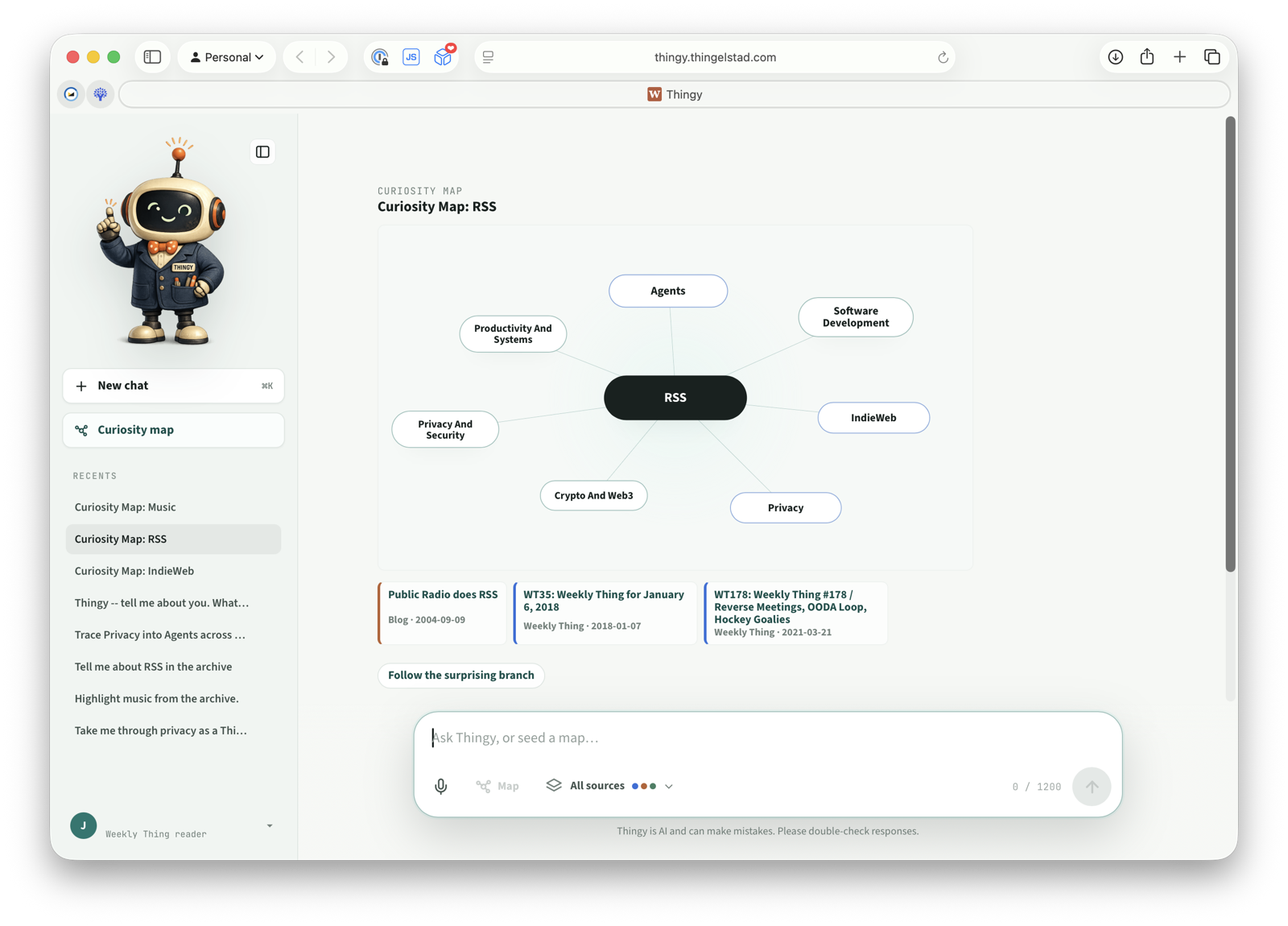
- Curiosity Maps!: This is probably the “show, don’t tell” feature. Instead of only answering questions, Thingy can draw a map of adjacent ideas from the archive. You can start with Thingy’s suggested map or seed it with your own topic.
- Richer Responses: Responses can now render tables, trails, maps, citations, action buttons, copy/share/play controls, and better markdown. This makes Thingy feel less like a chatbot bolted onto an archive and more like an interface for wandering through ideas. Thingy also shares its thinking process with you as it works!
- Voice Input: You can talk to Thingy now. It is not a full voice conversation mode, but speech-to-prompt makes the experience feel more natural, especially on mobile.
- Mobile Experience: The mobile interface got a major rethink: chat-style header, conversation drawer, floating composer, cleaner controls, and a more app-like feel. This matters because Thingy now feels usable on a phone, not merely responsive.
- Memory and Personalization: Thingy can remember user preferences like name and use prior conversation context. It can welcome returning users differently from new ones, and the experience can become more personal.
- Thingy Identity: The UI moved away from a publication aesthetic and toward a dedicated chat client with Thingy’s own visual presence. The larger rail image, cleaner composer, and simplified interaction model make it feel like its own thing.
- Based on Elixir I know that Discord is a reasonable place for an agent to run.
- Based on building Thingy I know that my Weekly Thing archive is a robust knowledge base to build off of.
- Based on sending issues that meander and are just too long sometimes I know an editor would be helpful.
- Based on my own time crunch that I get into when I’m trying to make a whole issue happen in one Saturday morning I know I could use some help making it more iterative.
- Eddy is my editor who reviews everything that goes in the newsletter. Eddy assembles a working draft of the current issue of the newsletter every day and then does an editorial review of the content. Eddy shares a status and progress indicator with me in Discord.
- Linky is my researcher who assists with assessing the links I flag to go into the issue. Linky does recon to allow me to filter faster. Linky doesn’t ever look at the current issue and is just assisting with curation. Linky shares these in Discord. I’ve made it so I can reply to Linky with my commentary and it sync’s it back to Pinboard. This has allowed me to turn my commentary into a conversation.
- Marky focuses on the most recent issue of the Weekly Thing that has been published and raising awareness. I’ve done the least with Marky so far, but the goal is to get the Weekly Thing to new readers.
- Patty is the supporting membership manager who helps create call to action to bring new members in and raise money for the nonprofit we have selected. Patty operates on the annual cycle of the membership program and is the only agent that will draft content that does appear (properly sectioned) in the Weekly Thing. Patty understands the goal of the program, the organization that we are focused on this year, and what I have been writing about.
- How has the arc of AI evolved in the Weekly Thing?
- Compare Tik Tok, Facebook, and X from the archive.
- Explain to me how Jamie connects Indie Web and Crypto? They seem very opposite to me.
- This doesn’t replace or remove my actual podcast, Another Thing. There is still just one episode there but I’m not giving up on that.
- The audio for the Weekly Thing is text-to-speech using a transformed version of the email text. It announces sections, gives links numbers, announces quotes, and cuts some sections. I’ve listened to a few and think it works reasonably well.
- I’ll probably evolve the generated audio, and right now it only exists for the last 10 issues, but I plan to backfill all issues with audio over time.
Thingy Evolved
I rebuilt Thingy into the archive agent I always wanted. Thingy started a month ago as an agent that acted as a librarian in front of the Weekly Thing archive. It did a great job at that and even if nobody else used it I found it super helpful to explore the archive. However, I quickly found that I also wanted Thingy to know about the 12,000+ posts on my blog in addition to the Weekly Thing. Oh, and my one episode Another Thing podcast should be available too. I wanted Thingy to know all of the information I have published.
Core to making this happen was to create semantic archives for not just the Weekly Thing, but also my blog and Another Thing. Once I had that foundation, I gave Thingy super powers!
The changes…
Thingy requires you to be subscribed to the Weekly Thing, and it will do the subscribing for you as you sign in. Give it a try! 🤩
The Weekly Thing Team
I’ve been publishing the Weekly Thing for nine years and automation is one of the things that has made that possible. I shared a while back how I find content, assemble the issues, and my project structure. Without these well defined workflows there is no way I could continue this project.
The structure I have has worked well but it isn’t autonomous. It only runs when I engage with it. It is also brittle and “one way”. I can only easily run it one time. Additionally I think I could use some help getting things collected and reviewing the in process writing.
To this end I decided to create my support team for the Weekly Thing!
My starting points were:
This is the genesis of my Workshop and the four agent team that I have now created to assist me.
One thing worth being clear about: I have stated many times that “My words are mine!” and not AI’s and that is still the case. I don’t have any of these agents working to write content for me. They are my support team. The words are still mine. The only case where an LLM is “writing” or engaging with anyone is Thingy, the librarian for the Weekly Thing, and the Supporting Membership program where I have an explicit preference that that be a different voice than mine.
Here is the broad outline of the multi-agent solution that allows me to have dedicated agents that focus on different aspects of publishing the newsletter each week. This allows me to focus more on writing and commentary!
Each of these agents are operating with a full set of tools that include the entire archive of the Weekly Thing. As a result they are much more tuned to the job at hand than a generic LLM.
I’m focused mostly on Eddy and Linky right now as they are core to my authoring cycle. I can already see that this is going to allow me to focus on the content more, will be a quality of life improvement to get more incremental content and less scrambling at the end of the publishing cycle, as well as a more readable final email to subscribers.
Massive Weekly Thing Website Build
I’ve commented that agentic coding makes things that were previously on your “list of impossible projects” into things that you can do. I have long had on my “impossible project” list the desire to create a website for the Weekly Thing that let the archive shine in ways that I knew were possible but no solution out there delivered. With 9 years of writing and 345 issues in the archive there is so much to surface.
To do this I knew I would need to build it on my own. I could use the Buttondown API to get the issues and make them accessible. But then I needed a website. I needed a content pipeline. Oh, and that archive has old formats from different platforms that were a mangled mess of HTML.
This was truly on the “impossible list” for me personally. If I wanted to spend tens-of-thousands of dollars, or probably even more, I maybe could have hired someone to build it. A laughable idea really.
So I decided to take my experiences with Claude Code, Claude Design, and Codex and point it at this problem. Over the last couple of weeks I’ve been working on the new Weekly Thing website experience.
I just have to say I’m so thrilled with the results that I can barely handle it. Rather than type a novel here I’m just going to list out what the site has. Even better, go there and explore:
https://weekly.thingelstad.com
Here is what the new site has!
1️⃣ Completely reimagined landing page to describe the Weekly Thing. Gone is the basic Buttondown paragraph of text and a signup button. The home page hopefully gives a much better feel for what the Weekly Thing is.
2️⃣ Archive page has full index of every issue back to number 1. This is also now optimized for the Weekly Thing with issue images, link counts, organized by year.
3️⃣ Thingy, the Weekly Thing librarian that has read every issue of the Weekly Thing and is ready to converse with you about all of it. I have wanted to make an agent like this for over a year and it is finally real. I’ve found this fascinating to play with and ask questions of.
You will see this feature requires you to provide your subscriber email address. It is only available to confirmed subscribers of the Weekly Thing.
You may recall in WT311 I shared a custom GPT that was sort of like this. That was grade school level. Thingy is much smarter!
Some prompts that are fun to explore with Thingy:
4️⃣ Search is now super powered. The searching is indexed into the section of the weekly thing. This works way better than before.
5️⃣ On the page for each issue you will see that there is a Table of Contents on the left. It is a little thing, but another example of something I’ve wanted for a long time. The Weekly Thing is long and this gives a way to navigate. Also, each of those items is a hyperlink so you can now send a link to a specific notable link in a specific issue.
6️⃣ Big one – you can now LISTEN to the Weekly Thing. I’ve filled this in for the last 10 issues. On the issue page there is a “Listen” button where it will be read for you.
7️⃣ Podcast? Well if I have an audio file for each issue why not bundle that into a podcast. So I did. You should be able to find the Weekly Thing on Apple Podcasts and Spotify. It is propagating through other platforms. Should be on Overcast too.
8️⃣ Support for LLMs.txt! This is a bit hidden, but if you want to talk with the LLM of your choice about the Weekly Thing, give the LLM this link:
https://weekly.thingelstad.com/llms.txt
That provides an LLM optimized index of the entire 345 issues, as well as links to LLM optimized versions of every email! This means ChatGPT or Claude or whatever else can dive deep into the content. I have actually used this myself when asking a model to do some research with me.
A quick note about the audio:
Take a look. Try out the archive, search, Thingy. Listen to an issue. And let me know what you think… anything not work right? Read wrong? Something missing? Or just that you think it is all cool?